2023
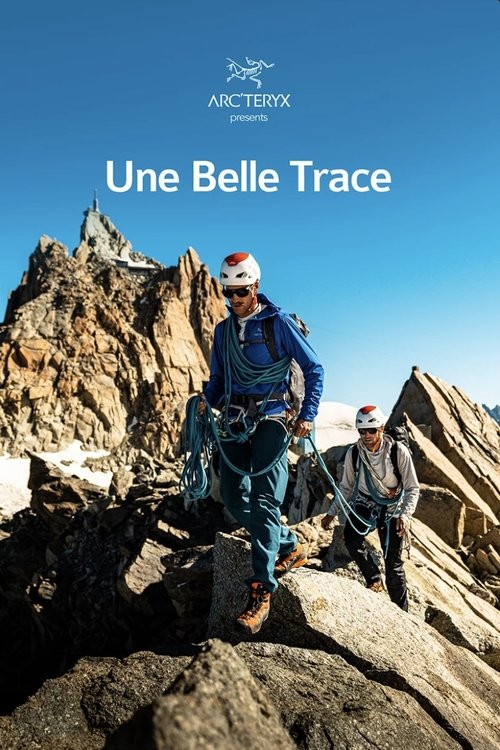
July 2022. Two high mountain guides, Frédéric Dégoulet and Benjamin Ribeyre embark on a journey around the Mer de Glace via the most legendary peaks of the Mont-Blanc massif.
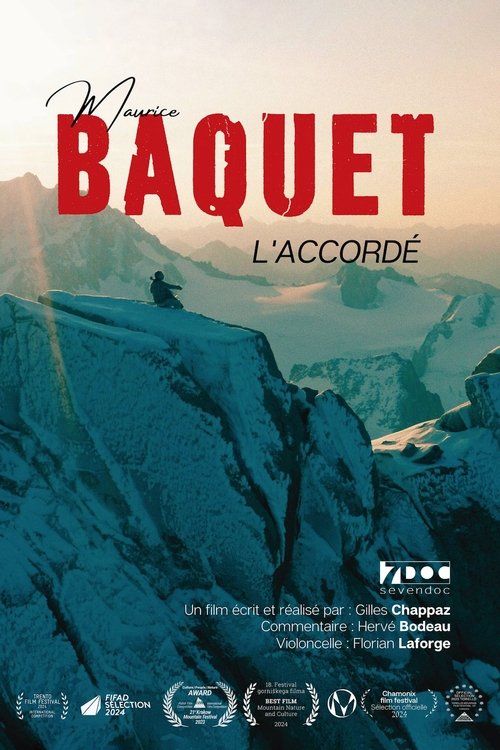
At once a high-level musician, member of the October Group, entertainer, theater artist, film actor, mountaineer, and skier, Maurice Baquet, always on the move, structured his life around two common threads: the cello and the mountains. He once defined himself as a "cellist-skier," "all alone" in this category, which prompted James Couttet, world ski champion, to say: "Of all the skiers I know, he's the best cellist." Echoing this, Professor at the Conservatoire National Supérieur, André Navarra, added: "Of all the cellists I know, he's the best skier." Throughout his varied yet coherent career, Baquet helped to project a joyful and artistic image of the mountains. Who better to talk about Maurice and all his adventures than his alter-ego: Cérébos, the faithful cello that never left his side? From Paris to Chamonix, from the stage to the granite slabs and snowy slopes, this film follows Cérébos, crossing the century and above all... smiling!
1947
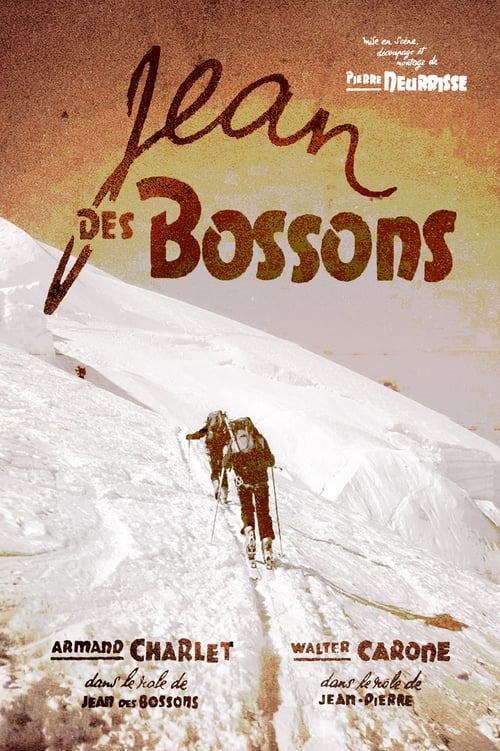
Jean des Bossons is a documentary-fiction which recounts the activities of a high mountain guide in 1947. Around Chamonix Mont-Blanc, the guide Jean des Bossons, interpreter by the mountaineer Armand Charlet, accompanies on mountain hikes, Jean-Pierre, an apprentice guide. The novice, skis on the shoulder, is already clumsy. The professional taught him how to travel on skis uphill and downhill, then mountaineering in ice and rock parishes. By dint of training, Jean-Pierre has made it his job. Guides are also lifeguards. A group went to a glacier to rescue a man who had fallen into a crevasse. During this rescue, Jean des Bossons is the victim of an accident. A drama that prevents him from practicing the profession, but not climbing. The man sinks into the fog and Jean-Pierre cannot find him.
2004
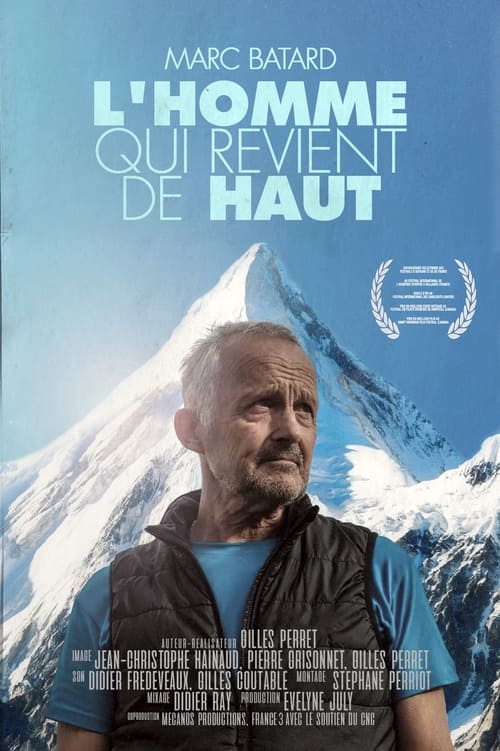
What compels a man to push the limits of what is attainable ever higher? After thirty years of relentless struggle with the highest peaks on earth, Marc Batard has finally found the answers to these questions. He had to reach the summit of Everest twice, once shattering the record for fastest time in 24 hours without oxygen, and climb the most difficult faces of the Alps to glimpse the path to inner healing. It was through physical suffering that he was able to confront the pain of his soul. He was finally able to talk about the violence of his childhood, the shock he carried like a ball and chain for decades. Having completed his summit therapy, Marc Batard tells his story in this documentary by Gilles Perret.
1924
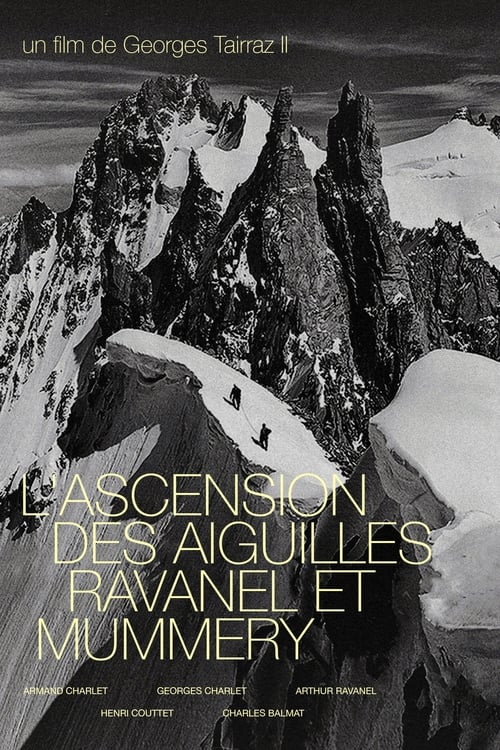
"The ascent of the Aiguilles Ravanel and Mummery", climbed by young guides in cycling pants: The brothers Armand Charlet and Georges Charlet, Arthur Ravanel, Henri Couttet and Charles Balmat. The film was shot by Georges Tairraz II, Chamoniard mountain photographer, representative of the third generation of a family line of mountain photographers and filmmakers. George Tairraz II's film will lay the groundwork for a French vision of mountain film; In the 1930s, a French school of mountain cinema emerged, less expressionist, more stripped down and realistic than the German school. These are the films of Marcel Ichac, Roger Frison-Roche, Samivel, Georges Tairraz II, etc. It develops according to the principles set by Marcel Ichac, in opposition to the German school. It is both about getting out of the dramatic vision of the mountain and placing the mountain and the climbers at the heart of the plot.
2008
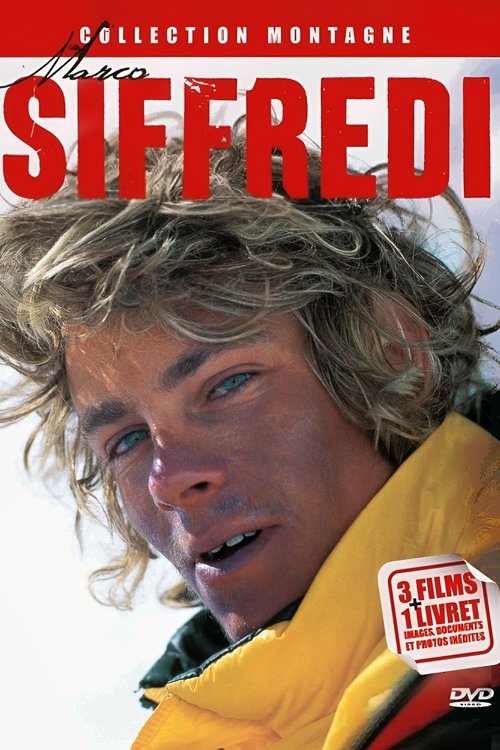
Avid for steep slopes, Marco Siffredi (1979-2002) obeys only one rule: not to fall. This gifted kid with hair sometimes blond peroxidized, green or blue clashed in his valley: Chamonix, mecca of mountaineering. His thing was to go up and down on a snowboard. . 90 minutes September 8, 2002, altitude 8848 meters, rare oxygen, his head already brushing the sky and his snowboard running, Marco Siffredi, 23, rushes from the summit of Everest in the Horbein corridor and its slopes at 50 degrees . A year earlier, he had already made the first descent of the mountain on a snowboard. But there remains another corridor… more direct. It's not a challenge, just a reason to be... However, that day, at the top of the roof of the world, his trace is lost...
1953
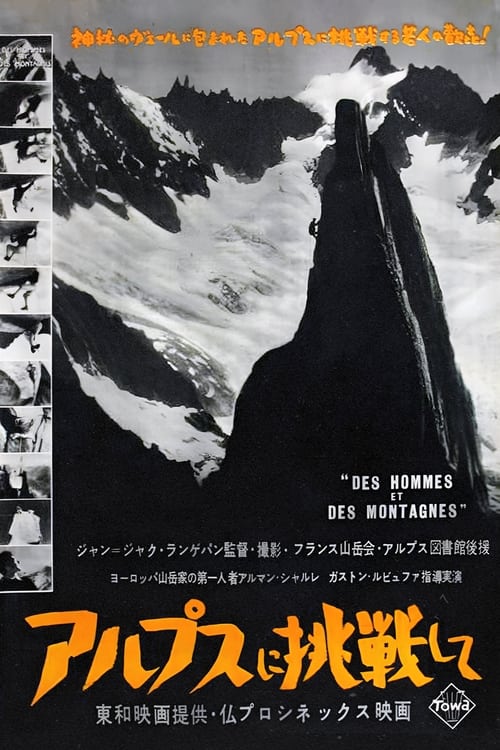
History, advice and demonstrations of mountaineering in the Mont Blanc massif by the renowned guides of the National School of Ski and Mountaineering from Chamonix. The film starts with an historical summary illustrating the aspirations and methods that lead man to conquer the mountains. Armand Charlet teaches mountaineering techniques and takes his students to the field for glacier or rock exercises. Gaston Rebuffat makes demonstrations of particularly dangerous climbs. At altitude, people move in solitude, cold and silence, like circus acrobats without spectators, but nothing stops the modern mountaineer.
1986
Mont Blanc, the highest peak in the Alps, rises to 4,810 m and was first climbed on August 8, 1786. Chamonix natives Jacques Balmat and Michel Paccard set out on the afternoon of August 7 and returned victorious on the morning of the 9th, after two nights spent outdoors. This film is a staging that reconstructs this great event with all the problems it created and resolved, thus contributing to the emergence of the modern concept of mountaineering. Denis Ducroz, guide and filmmaker, immerses us in the minds and times of these two men, 224 years later.