2008
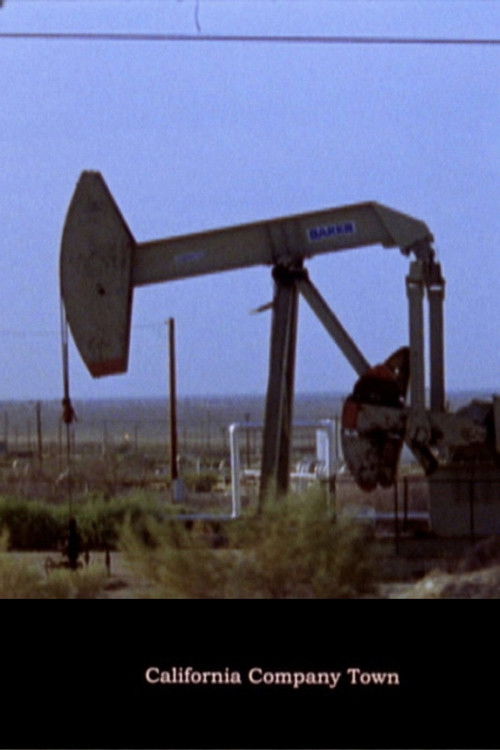
Lee Anne Schmitt explores California's landscape and past to document the history of one-time boom towns built and abandoned by the industries that necessitated their creation. Sold as a limitless land expansive with free opportunity, California was actually, from its onset, fissured by the interwoven needs of private and public interests. Schmitt's film covers various locations through time, as the major industries of the early 20th century (mining, lumber, oil) give way to the military, eventually leading to multinational corporations, and the use of small towns as satellites for growing urban metropolises.
2007
Christof Wackernagel, best known in Germany as an actor and former member of the Red Army Faction ("RAF") lives in Mali. In his compelling portrait, Jonas Grosch shows a man who simply cannot stand still if he senses injustice. The courage to stand up for one’s beliefs coupled with vanity? However one chooses to look at it, it is easy to imagine what made him connect with the "RAF". With his irrepressible will for freedom, Christof Wackernagel gets entangled in the horrors of day-to-day life in Africa.
Documentary that shows the changing attitude towards immigrant labor in The Netherlands. The documentary follows three immigrants that arrived in Holland 30 years ago to work in a bakery.
1955
2020
1970
What happens to two dying coal towns in British Columbia when an American corporation provides a contract for millions of tons of coking coal? The film follows the consequences for the towns of Natal and Michel, suggesting that industrial growth has its price, especially with regard to the environment.
1999
2024
Britain feels under-funded and falling apart. On the eve of the election, as politicians debate the causes, economist Tim Harford looks at what the numbers reveal about the broken state we're in.
1966
A portrait of Hamilton, the Pittsburgh or Birmingham of Canada. This is a rich and colourful subject that encourages imaginative treatment on the screen. The heart of the city is the immense complex of furnaces and rolling mills, but nearby are the lake, the mountain, and the rich fruit farms. How the work of the steel mills touches the city and its surroundings is shown in many views during both day and night.
1939
Promotes television sets and the broadcast of New York's first regularly scheduled programs by providing a clinical look at the inner workings of television, including the manufacture of the tubes, lab experiments, and an actual telecast. Shows RCA's production studios in Rockefeller Center, television demonstrations at the 1939–40 New York World's Fair, RCA's Empire State Building transmitter, and remote mobile broadcast units. One of a variety of "Reelisms" shorts produced by Frederic Ullman Jr. and Frank Donovan for RKO in the late 1930s.
1888
The earliest surviving motion-picture film, and believed to be one of the very first moving images ever created, was shot by Louis Aimé Augustin Le Prince using the LPCCP Type-1 MkII single-lens camera. It was taken on paper-based photographic film in the garden of Oakwood Grange, the Whitley family house in Roundhay, Leeds, West Riding of Yorkshire (UK), on 14 October 1888. The film shows Adolphe Le Prince (Le Prince’s son), Mrs. Sarah Whitley (Le Prince’s mother-in-law), Joseph Whitley, and Miss Harriet Hartley walking around in circles, laughing to themselves, and staying within the area framed by the camera. Roundhay Garden Scene is often associated with a recording speed of around 12 frames per second and runs for about 2 to 3 seconds.
2015
The environmental problems caused by fracking in America have been well publicized but what's less known are the gas industry's plans for expansion in other countries. This investigation, filmed in Botswana, South Africa and North America, reveals how gas companies are quietly invading some of the most protected places on the planet.