2023
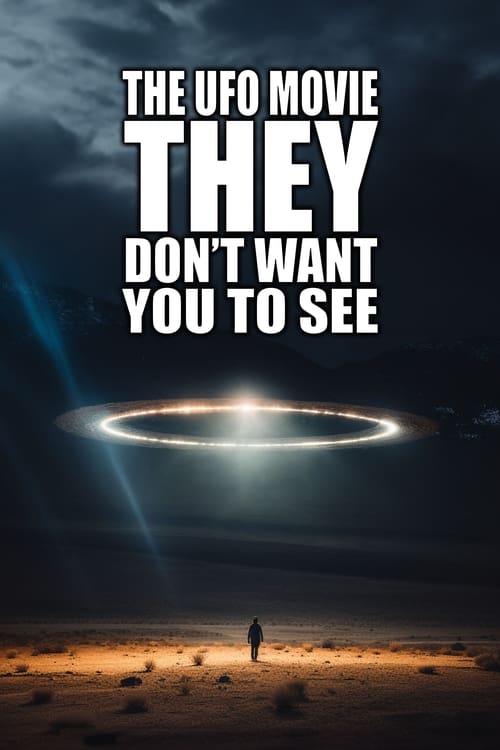
In an age when misinformation, alternative facts, and conspiracy theories have become mainstream, UFOs have risen to become one of the most-talked about pop culture phenomena. With all of this noise, how can we expect anyone to know how much of this is true? What is in our skies? What do we know, and how do we know it? And most importantly: Are we being visited?
2000
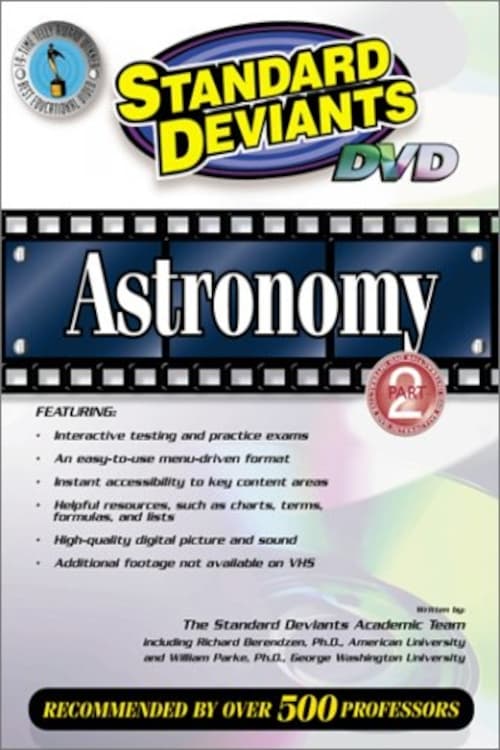
In Astronomy Part 2, you will learn all about the planets, asteroids, comets, meteoroids, the layers of the sun, fusion, and more. The Standard Deviants make learning astronomy easier with their unique teaching style, which incorporates humor, mnemonics, and sophisticated computer graphics.
2002
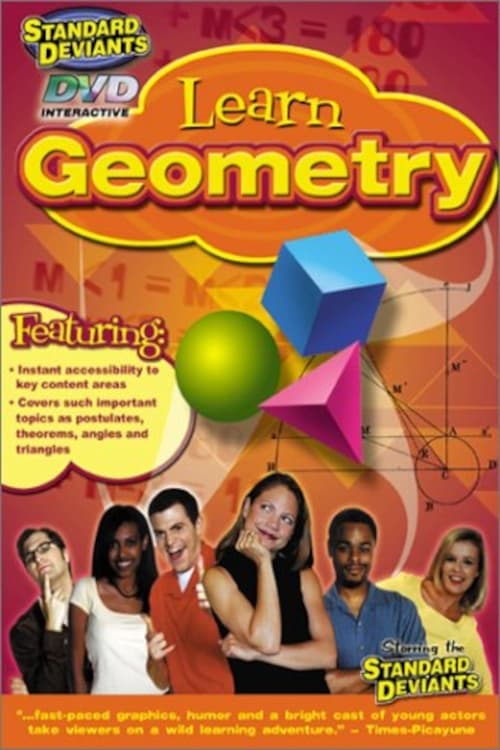
Every year, millions of high school and college students walk into their first geometry class thinking: "Circles and squares. How tough can it be?" Then they encounter the postulates, statements and theorems! But have no fear, our simple, straightforward format will help students understand and make sense of geometry.
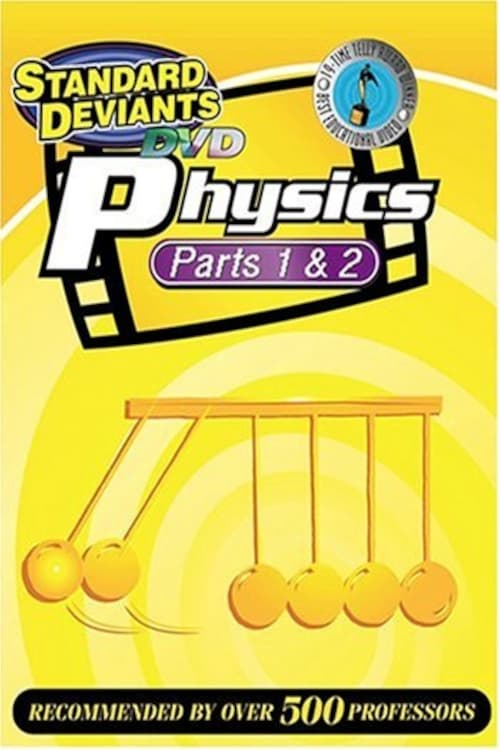
Physics is a system of models of nature according to which all phenomena are explained in terms of matter and force. Sound confusing? It doesn't have to be! Whether you need help with high school physics, need to review for a college physics class, or you're studying for the AP Physics Exam, this physics tutorial will help you understand the basics, such as Newton's Laws, the Law of Universal Gravitation, Kepler's Law and more.
2004
This DVD dives into the advanced principles of Algebra. The Standard Deviants tour of the world of algebra continues with complete coverage of quadratic equations, quadratic roots and factors, and higher order polynomials. Suitable for all ages, Algebra Part 2 clearly presents these principles in a fun and approachable manner. A completely stand-alone video! Part 1 is not required.
2008
The Standard Deviants serve-up all sorts of useful trig vocabulary. Get your fill of degree and radian measurements, and a sampler platter of right triangle trigonometry.
1997
This edition of Trigonometry includes such topics as radians, the special angles, right triangles, the Pythagorean Theorem, sine, cosine, tangent, law of cosines and law of sines.
Part 2 starts off with a quick review of graphing as well as sine, cosine and tangent. From there, this video charts new territory as we dive into amplitude, curves, double-angle formulas, sum-to-product-formulas and identities. Using computer graphics and animation, the Standard Deviants illustrate these complicated concepts far better than any blackboard!
1999
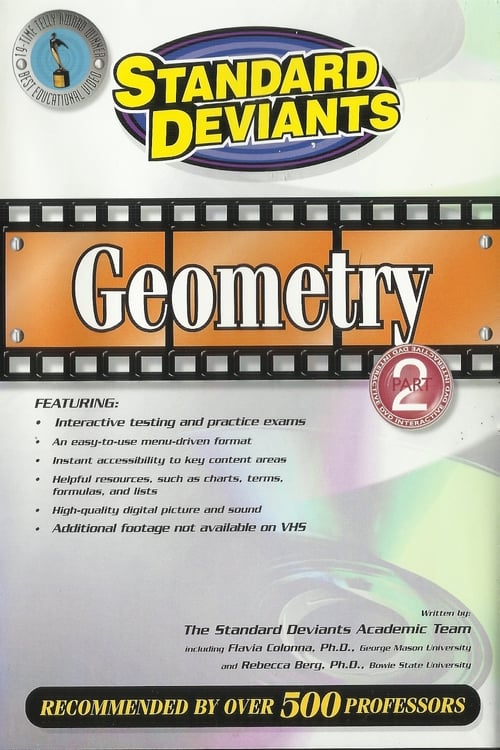
Geometry Part 2 goes into detail on perimeter, circumference and area for 2-dimensional and 3-dimensional figures. This DVD is also helpful for students who need extra help understanding the Pythagorean Theorem. Difficult concepts are made crystal clear with easy-to-follow examples and graphic presentations. With the Standard Deviants by your side, you'll be calculating the surface of a sphere or the volume of a cylinder in no time!
1986
The Movie Movie shows how the camera, editing techniques, make-up and sound can be used in film and video to deliberately manipulate our perceptions and emotions. Drama, action and slapstick humour are combined in a simple, family-oriented plot. There is no dialogue, but there is an explanatory song. Behind-the-scenes vignettes highlight the message that in a movie everything is not quite as it seems.
2024
A documentary feature film which aims to expand the usually one-sided conversation between students and teachers. During its runtime, raw experiences heard from all sides of the conversation are laid bare during its 77 minute runtime. From all of these interviewees, including a student, a school psychiatrist, and five teachers, the viewer shouldn't expect to be confronted with a narrow perspective but rather a question: "where do I stand?"
2019
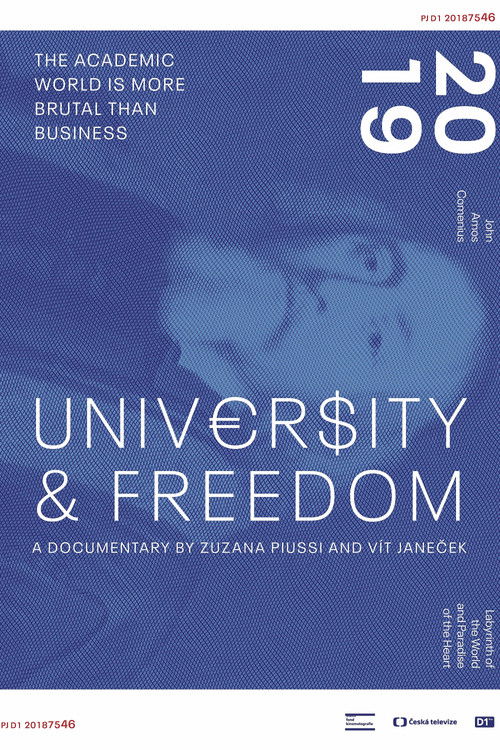
Our era is marked by the transformation of social institutions, with universities central to Euro-American civilisation’s development. Despite past persecution, universities have become bastions of free thought and knowledge, crucial to democratic culture. However, commercialisation and massification have introduced challenges affecting teaching, research, self-governance, and the system overall. How do universities maintain academic freedoms, and what are the consequences of their failure? Can we identify and address these challenges?